Growing up, when I’d go to the grocery store, I made a beeline for the magazine section. Tiger Beat. Heart Throb. Seventeen. Sassy. All those celebrities with their perfect skin, perfectly coiffed hair… perfect… well, perfect everything… Even their bodies didn’t have a single flaw. I came to find out that they were “airbrushed." Back then, airbrushing was something that was done at a mall to a t-shirt. I had no idea that airbrushing could be done to photos, let alone to people’s bodies.
Table Contents
As I got older, airbrushing became photoshopping. And I knew what that was because I was a professional photographer and I had done my share of it myself. Removing acne. Wrinkles. Bags under eyes. Suddenly people realized that portrait photographers could digitally nip and tuck, which is how an entire generation of flawless people (mostly women) ended up on walls and in their photo albums.
Once filters became sophisticated enough to be used on mobile devices, you have to wonder: does anyone look like their profile picture or video in real life?
Things started off not so different with AI.
Airbrushing for the pros. Seemed so fancy until we all got our hands on it, and now your Uncle Bob is posting long-form content about string theory on LinkedIn, and you’re left wondering when he’s even heard about quantum mechanics, let alone studied enough to have a deep enough opinion to form a post that long. Plus… what does that have to do with dentistry?
This isn’t an AI bashing post. It has its place and to be fair, I use it ALLLLL the time. Going on vacation. Fashion trends for short mid-sized women knocking on the door of 50 years old. Meal planning. Organizing my data with incredible spreadsheets. HubSpot solutioning. Understanding grief following my dad’s death (I’m a feeler but I’m also a thinker and that’s a horrible combo at 2 a.m.). Marketing trends. Understanding how the sales landscape is shifting.
The point is — I use it a lot.
The problem is in what we were promised: that it would make us subject matter experts. But did it? You can look up first-level questions, but can you get 3 questions in and still hold your own in a conversation? Do you really want your dentist to get into the weeds about quantum mechanics or would you rather him focus on the health of your teeth?
What I’ve noticed is that we’ve just allowed AI to be the filter for our brains.
We’re all so polished and perfectly well spoken. No typos, no run-on sentences. Written language has suddenly been perfected when, once upon a time, we could pick out with remarkable ease who ditched 7th period English. And the research on this topic isn’t very encouraging: when we copy and paste whatever the robots tell us, most of us aren’t learning anything. Actually, to the contrary - there is evidence that heavier use results in a decrease in cognitive function. Is this the same, the world over, in every single person and every circumstance? No. But it’s hard to argue that LinkedIn hasn’t been overrun with AI slop.
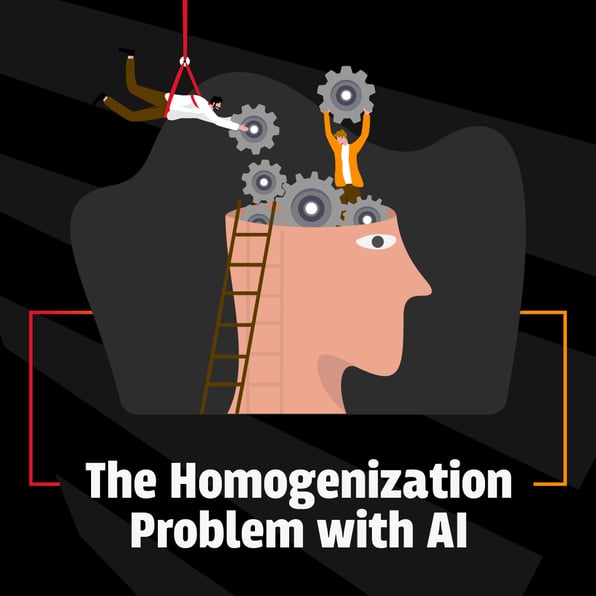
The Homogenization Problem
Years ago, I sat on dozens of consulting calls with customers who were just discovering the glory of generative AI. These customers used AI to rewrite their websites, their blog posts, their social posts, their emails and now - now everything they say sounds like everyone else who says anything. They thought AI would be the magic wand to make all of their content marketing better. As it turns out, it was homogenizing language across every brand and every industry.
It’s not that these businesses aren’t doing good work with good people. It’s that the way people find those businesses has changed. AEO and zero-click search prioritize answers written in the way people actually talk. Generative AI doesn’t sound conversational because it didn’t start that way. Now your traffic has dwindled to nothing and your lead funnel has withered on the vine. Your sales team is desperately prospecting to cold leads while your marketing team is trying to prove value in a landscape that has flipped upside down.
Why this is actually an AEO Problem
Here’s how it works: AEO and zero-click search prioritize content written in the way people actually ask questions and expect answers, rather than how a brand positions itself using benefit statements. Generative AI doesn’t sound conversational because the content it was trained on (millions of websites) has copy that uses features-and-benefit language. Real people have never spoken that way. A couple of examples:
AI: What are the benefits of implementing a new sales process?
Real people: Why can’t my sales team close deals?
AI: How can businesses improve customer retention?
Real people: Why do I lose customers after the first order?
AI sets up to brag about features and benefits. People talk about symptoms.
If your website and content are written with feature and benefit style language, you’re not being matched with the actual “real people” style query and an answer engine won’t pull your page into its answer box over a competitor’s. Zero-click search doesn’t pull the best looking website or even the website that has the best answer. It pulls the website’s content that matches the question as closely as possible. If you sound like everyone else in that space, there’s no way to differentiate you in the ranking, which means you won’t get pulled at all.
So when people tell you to optimize for AEO, it’s not a checklist of meta tags. It’s a language first problem.
What do you do about it?
Find the actual questions for your ICP types. This should be a brainstorming session with your sales team. If you have recorded calls or transcripts, you can also review those using AI (an excellent use case for it!) to validate what your team has come up with and anything they’ve missed. It’s important to remember that the questions must remain in real-language queries.
The next step can be a little… humbling. Ask yourself, does the content on my website answer the question using AEO real-people language? Or is it stuck in feature-and-benefit land?
From there, you know what to do.
According to an independent survey by Acquia, 70% of marketers believe that AI will significantly impact the digital strategy of their organization. However, only 20% have started to implement it. Webflow insights back this up but go a step further: they surveyed 2000 websites and found that 88% of website’s content was holding them back to some degree.
This means that 12% of organizations are doing well. If you fall into the 88%, and you’ve used AI to any degree, AEO will not pull you because your website may sound like everyone else.
If this is ringing any bells for you, you’re not alone. I see this with most clients I’m working with. Great information, wrong setup. Don’t blend in with the crowd. Schedule some time with me and I’ll show you what’s holding your website back.