Design is so much more than colors and pretty graphics, it’s how your business tells its story, it’s how users perceive and react to your website, and it’s how users experience your brand.
Content is so much more than just the words on a page. It’s how your business tells its story, it’s part of how search engines determine the value of your site, and it’s how users experience your brand.
Notice the similarities between those two points?
Table of Contents
The Design Decisions a Writer Makes
The Content Decisions a Designer Makes
We can’t escape our “caveman brains”
How We Handle Content and Design: Plus, Our Best Tips for You
Turning the Complex Simple: A Creative Challenge
Website and UX design need good content to shine, just as much as content needs good design to accurately present the message. When one falls short, the other can only do so much to make up for it. A lot of times we get asked, or even debate internally, “should we design around the content or write around the design?”
My answer? Both.
When your designer has a sense of effective content structure and your writer understands how a user will experience what they write, you get a team capable of creating a beautiful thing.
As a designer, I enjoy the puzzle of taking written content and piecing it together into a readable flow supported by an effective design.
The Design Decisions a Writer Makes
When writing web copy, a content writer benefits from having some design knowledge. Not that the writer needs to fully wireframe a page for the design team, but for example, understanding what makes a homepage work makes all the difference. Thinking about page copy as appealing, concise language rather than an essay and considering how a user flows through a page of content are strong skills for a content writer.
Writers should consider natural breaks, clear headline structure, relevant groupings of content, and mixing in lists, instead of paragraphs. A writer considering how a wordy paragraph can instead be turned into a digestible grid of key points is a great way to support designers.
Which example do you find the easiest to skim?
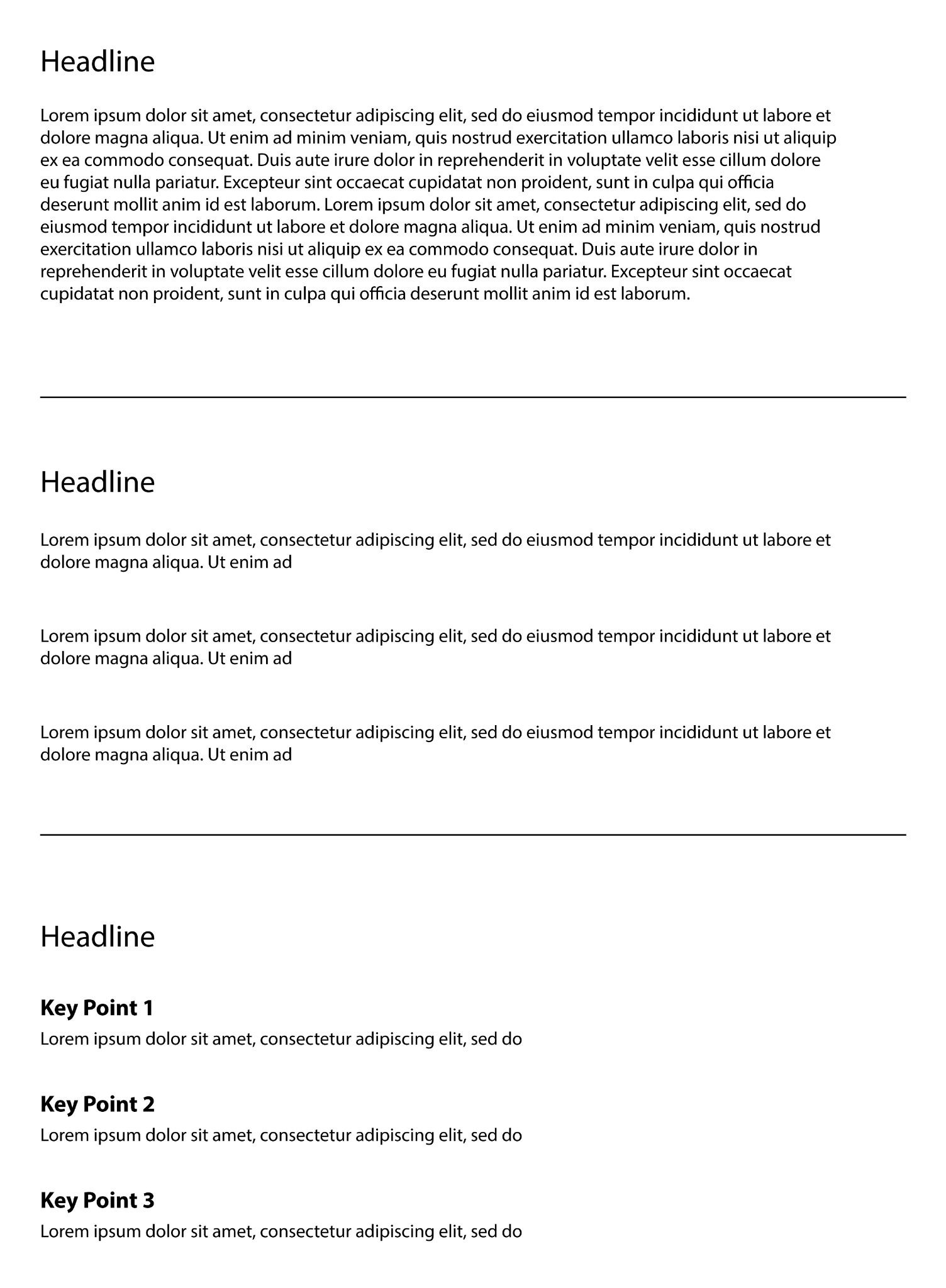
I’d go out on a limb and say you probably gravitated toward the last option. While short paragraphs have their place, especially when it comes to maintaining an effective content density, simple lists and other creative ways of presenting information are some of my favorite creative challenges when it comes to both writing and design. Keep it collaborative!
The Content Decisions a Designer Makes
When designing a web page, designers have to do more than simply make it look good. They have to make it easy to use and effective at guiding users where they need to go.
When working with written content, designers think about how a message can translate into digestible, easy to read sections with clear headlines and relevant calls to action. Most users don’t want to read a paragraph on your website; they want to skim through, find out if you offer a solution to their problem and find the way to get it, all as quickly as possible. The rest comes after you’ve captured their interest.
Just like writers, designers benefit from being able to recognize when to take long written content and break it out into easy-to-read pieces and when the content has a natural break, where an effective call to action can be placed.
Alternatively, sometimes the content is set in stone. In this case, a designer really needs to be creative and flexible to ensure they can create their vision while adhering to the guidelines set in place. You just have to make it work sometimes and that’s the mark of a strong designer.
We Can’t Escape Our “Caveman Brains”
Attention spans are short and everyone is skimming. You’re skimming as as you read this and you know what, you probably missed the double word in this sentence. Did you go back and look? The less work a user has to do to find the information they need, the more likely they are to convert.
That’s why…
When it comes to UX, headlines are more important than body copy
Skimmability is paramount on a homepage. You can get a bit more into the weeds on interior pages where higher-intent users typically navigate. But, your homepage should be so simple that a user only needs a few seconds to learn what you do and how to get it. If you can’t accomplish that, your users won’t make it any further into the site. My general rule of thumb is:
You should be able to get everything you want out of a homepage without having to read a single word of body copy.
And that’s where creativity comes in, designed in a way that guides users to key messages throughout a page and written in a way that’s quick to understand, answering the user’s burning question, “Are you the solution to my problem?”
Creativity is challenged when you need to turn a whole concept into a single dang good headline.
How We Handle Content and Design: Plus, Our Best Tips for You
An example of a collaborative team looks like this:
“Hey writer! As this design comes together, I’m thinking it would make sense to break this paragraph up into a few smaller chunks since there’s already a paragraph before this, can you help me write some sub-headlines for each key point in the paragraph?”
“Hey designer! As I write this page, how many bullet points would best fit the layout? We should also include a call-to-action in this section. Since we just listed our value props, this could be a great natural pause to ask for a conversion.”
During the design process, our designers work with our writers to establish how we can fit content into design. That often involves tweaking the design or the content to fit the other, depending on the project.
Turning the Complex Simple: A Creative Challenge
Tell your users about your contracting company history and how you’ve been in business since 1945. That’s a great value prop. But don’t make them search through a paragraph for that information, because they won’t. Headline it with something like “Partnering with Contractors for over 80 Years.” Whether someone reads the paragraph or not, they’re digesting that value.
It’s easy to write an entire page about your business, and sometimes, that’s what we ask our clients to do. But what’s hard is taking that essay, or giant list of bullet points, and turning it into web copy that flows.
If you’re creating your own website, here’s a few tips to consider when creating your homepage.
-
Establish your highest value content that best supports your story. Not everything needs to be on the homepage.
-
Group your content into buckets that tell your users “Here’s who we are, here’s the problem we solve, here’s why it’s good, here’s how to get it”. Things like:
-
Introduction / “Hero” section
-
Product/Service info
-
Value props
-
Social proof like awards and testimonials
-
Examples of your work
-
Resources that help a user make a decision
-
A final call-to-action that tells them exactly what to do. “Buy Now.”
-
-
Keep it simple and clear. Headlines should be straightforward and invoke emotion and trust in your brand. There’s always a balance between a snappy tagline and a clear message. If you’re going the fluffy route, try to pair it with a secondary headline that clearly explains your offering.
The Big Ol’ Asterisk
As a full-service agency, you didn’t expect us to set this topic down with just content and design, did you?
Of course not! Because that “Big Ol’ Asterisk” is the fact that Web Developers, SEO Experts, and Sales and Marketing teams exist, and they’ve claimed a slice of this pie, too.
Wait till you hear that all of these disciplines need to work together to make an effective and beautiful website. There’s a lot of moving parts in this art, so let us know how we can help.
Looking for more on this topic?
Check out our blog on why multi-disciplinary creatives are more important than ever. Read Now